

Surgical Guide Design

Implant guides designed from the dentist's CBCT plan and built for the drill kit actually being placed — with seating stops you can verify before the first osteotomy.

A surgical guide that does not seat the same way twice is worse than no guide at all — it moves the osteotomy with confidence in the wrong direction. Most of that risk is decided before anything is printed, in the choice of what the guide is supported by and whether the records actually capture it.

Jahn De Khudikine, Founder · Universal Dental Lab
Jahn De Khudikine Founder · Universal Dental Lab

Why send it here

A guide is only as good as what it seats on. We settle that before anything prints.

A practice's schedule lives or dies by the lab — I've watched one late case push back a whole day of chair time.

So I still know the cases moving through this lab, and I answer for how each one is made. Send a case here and it doesn't drop into a queue — it lands with me and one technician who carries it start to finish.

Start a case
You approve first
Nothing prints until you sign off on the design Changes at this stage are a conversation, not a remake
Built for your kit
Sleeve and offset match the guided kit you place The guide on the model matches the sequence in the operatory
Your technician
One planner holds your case Reach them directly — no call-center queue
Free scanner
3Shape TRIOS 6 for partners Go fully digital at no cost
Universal Dental Lab Surgical guide sheet

What to send with the case

  • CBCT scan (DICOM)
  • Intraoral scan, both arches (STL)
  • Bite registration
  • Implant system and platform
  • Guided protocol (pilot / partial / full)
  • Planned restoration or wax-up, if any

A scan that is vague where the guide seats is the single most common reason a guide fits loosely.

How We Work With You

A Guide Is Only As Good As What It Seats On

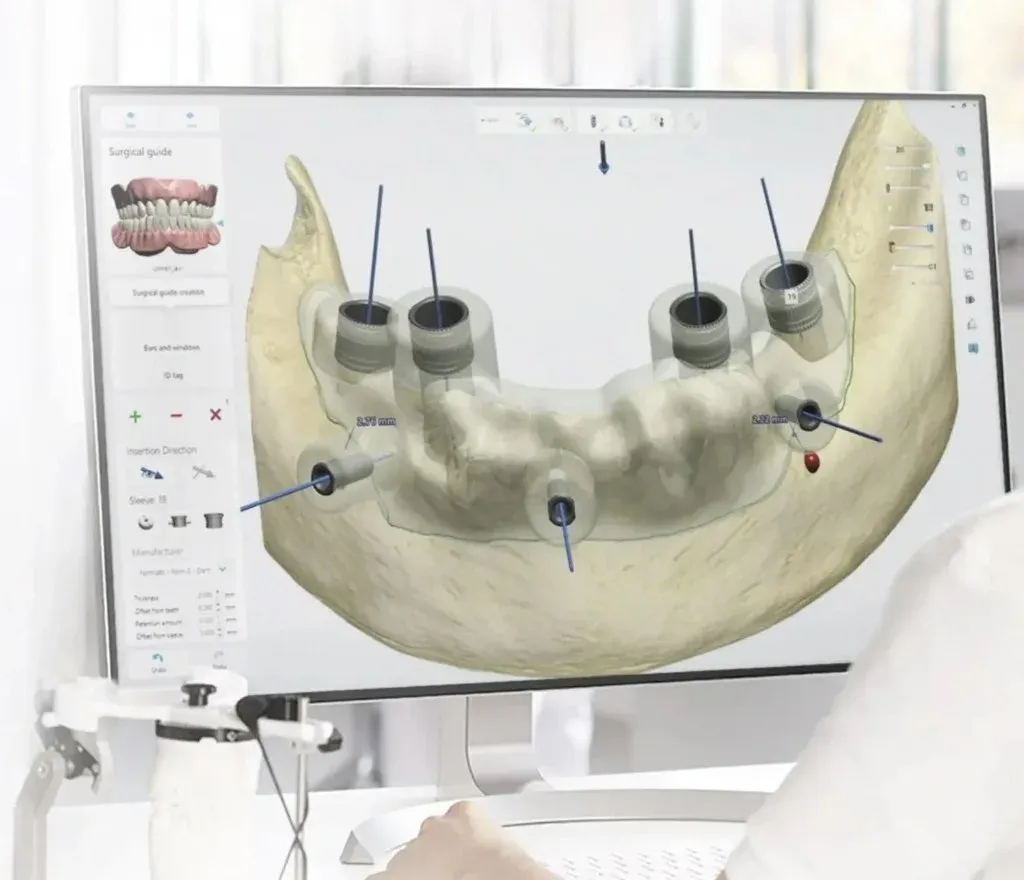
Our surgical guide design starts from your approved implant positions and works backward to a guide that serves them. Sleeve placement, drill offset, and access are set against the plan, and the support type is chosen for the case rather than defaulted.

Support decided first
Tooth-, tissue-, or bone-supported is chosen for the arch in front of us rather than defaulted. Where there are enough stable teeth, a tooth-supported guide seats crisply; edentulous and full-arch cases move to tissue- or bone-supported designs that need fixation and a different confirmation strategy.
Designed against the plan
Sleeve position, drill offset, and access are laid out from the approved implant positions, not the other way around. The guide is built to serve the restoration, so it is designed backward from the planned result.
Verifiable seating
Inspection windows and positive seating stops let you confirm the guide is fully home before the first osteotomy, instead of trusting that it dropped in cleanly.
Surgical guide design software with sleeve positions set against planned implant positions on a CBCT

The Guide

What Decides the Fit Before Anything Prints

The CBCT drives the implant position; the intraoral scan drives how the guide seats. Where there are enough stable teeth, a tooth-supported guide seats crisply and is easiest to verify. Edentulous and full-arch cases move to tissue- or bone-supported designs, which need fixation and a different confirmation strategy. We pick the support type for the arch in front of us and tell you what it demands during placement.

  • Support type: Tooth-, tissue-, or bone-supported, chosen for the case — the decision where most seating problems start.

  • Records that index the guide: For a tooth-supported guide the occlusal and interproximal surfaces have to be captured cleanly, because that is the surface the guide indexes to.
Learn more
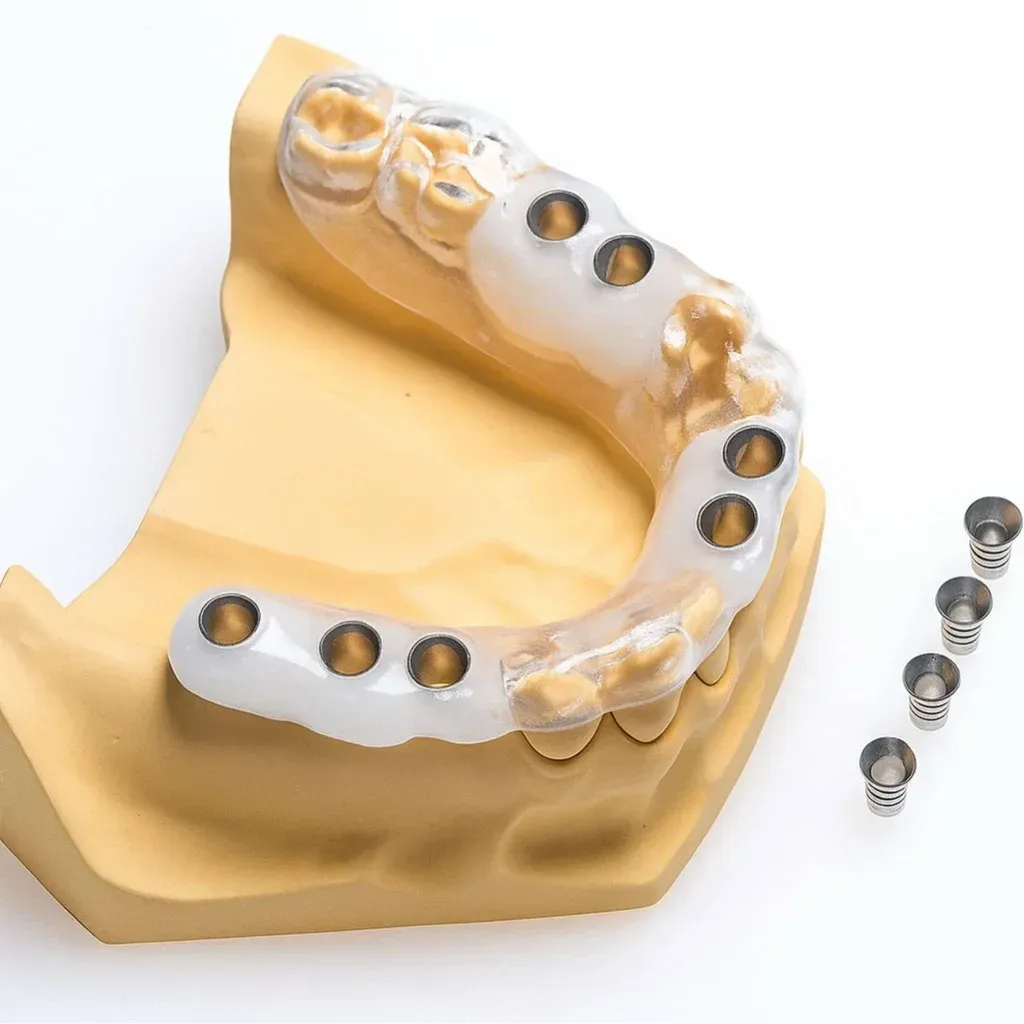
Finished printed surgical guide with metal sleeves seated on the model

Materials & Fabrication

Printed in Biocompatible Resin, Sleeved for Your Kit

Guides are printed in biocompatible guide resin and finished with metal sleeves matched to the implant system and guided kit you are placing. The sleeve is the tolerance the whole case relies on, so it is seated and checked against the plan before the guide leaves the lab.

Every guide ships with the drill protocol it was designed for. If the case calls for a change in support or offset, we raise it before production rather than shipping a guide that assumes a kit you are not using.

  • Metal sleeves: Diameter and offset built for the specific implant system and guided kit, seated and checked against the plan.

  • Ships with its protocol: Every guide leaves the lab with the drill sequence it was designed for.

Learn more

Where guided surgery has limits

A guide constrains the drill; it does not fix a plan that ignores restorative space, buccal plate, or interarch clearance. For full-arch work the guide often pairs with a bone reduction guide, and the two are designed as one sequence, not separately. Where the restorative problems belong is upstream, in implant case planning, so the guide is built to serve a restoration that already holds together.

The Process

How a Surgical Guide Is Designed

From your records to a verified guide. Nothing prints until you approve the design.

  1. Send records and intent

    Practice

    A CBCT in DICOM, an intraoral scan of both arches, a bite registration, and the implant system and platform you plan to place. Tell us whether you want a pilot, partially guided, or fully guided protocol.

  2. We check what supports the guide

    Lab

    Tooth-, tissue-, or bone-supported changes everything about how the guide seats and stays put. We confirm you have enough stable teeth, adequate scan quality, and the right support surfaces before we design anything.

  3. Design against the restorative plan

    Lab

    Sleeve position, drill offset, and access are laid out from the planned implant positions, not the other way around. We add inspection windows and defined seating stops so you can verify the fit chairside.

  4. You approve the design

    Practice

    You see sleeve placement, support type, and the drill sequence it is built for before anything prints. Changes at this stage are a conversation, not a remake.

  5. Print, finish, and ship

    Lab

    We print in biocompatible guide resin, seat the metal sleeves, and inspect the guide against the plan. It ships with the drill protocol it was designed for.

What a well-designed guide gives you

  • The guide matches your drill kit

    Sleeve diameter and offset are built for the specific implant system and guided kit you are placing, so the surgical sequence in the operatory matches the guide on the model.

  • Support decided before you print

    Tooth-, tissue-, or bone-supported is chosen for the arch in front of you — not defaulted. That decision is where most seating problems start, so we settle it first.

  • You can verify it seats

    Inspection windows and positive seating stops let you confirm the guide is fully home before the first osteotomy, instead of trusting that it dropped in cleanly.

Start a case

Send one case. Keep the scanner.

Open a partner account and your first case moves with a shade record and our remake guarantee — if a unit does not seat, we redo it at no charge.

  • Free 3Shape TRIOS 6 scanner for active partners
  • Under-2% remake rate — remakes at no charge
  • One named technician you reach directly — no call center

Prefer to talk? +1 747-268-0808

No call center — you hear back from the lab, not a bot.

Surgical Guide FAQ

Surgical Guide Design — Questions Dentists Ask

It depends on what stable anatomy you have on the day of surgery. Tooth-supported guides need crisp occlusal and interproximal capture on the scan; edentulous arches move to tissue- or bone-supported designs with planned fixation. We confirm support type before CAD so the guide you receive actually seats in the mouth you scanned.

Tell us the kit and protocol you will use chairside — that drives sleeve height, drill offsets, and whether the guide is for initial osteotomy only or full depth. Mixing a guided plan with a freehand kit at surgery defeats the purpose; match the RX to the hardware you will open in the operatory.

How to send a file

Yes, when the plan file includes the positions, platforms, and restoration target we need. Often the cleaner path is guided implant planning here so merge quality and prosthetic checks happen once, then guide design exports from that approval. Send what you have and we will say if anything is missing for sleeves and stops.

Guided implant planning

This service is CAD for the guide — support surfaces, sleeves, seating stops, and inspection windows from your CBCT plan. The product catalog page is where many practices order the printed guide built from that design. Design first when positions or support type still need lab input; order fabrication when the plan is locked.

Surgical implant guides

Unstable support — a scan that missed undercuts, soft tissue that moved, or teeth that were since prepped differently — and plans that ignored the restoration. We add positive stops and windows so you can verify seating, and we flag questionable support during design rather than after printing.

Partner Offer

A Free Intraoral Scanner for Partner Practices

Partner with Universal Dental Lab and we place a 3Shape TRIOS 6 Wireless in your operatory — free for the length of our partnership. Scan the prep, send it in seconds, and skip impressions entirely.