

Bone Reduction Guides

How much bone comes off is decided by the prosthesis going on — and by where the lip will hide the join. We plan both with the dentist before the flap is raised.

The first question a reduction answers is whether the framework has a platform to sit on. An irregular ridge gives you inconsistent prosthetic height across the arch; a referenced, flat reduction gives the framework a predictable surface — and that is what makes the fit repeatable from one end of the arch to the other.

Jahn De Khudikine, Founder · Universal Dental Lab
Jahn De Khudikine Founder · Universal Dental Lab

Why send it here

Reduction is a restorative decision made with a bur. We make it with you, before the flap is raised.

A practice's schedule lives or dies by the lab — I've watched one late case push back a whole day of chair time.

So I still know the cases moving through this lab, and I answer for how each one is made. Send a case here and it doesn't drop into a queue — it lands with me and one technician who carries it start to finish.

Start a case
You approve first
The reduction level is signed off before anything prints Adjusting the plan is a conversation; adjusting bone is not
Prosthesis-driven
The bone is planned to the prosthesis and the smile line The transition line ends up where you put it
Your technician
One planner holds your case Reach them directly — no call-center queue
Free scanner
3Shape TRIOS 6 for partners Go fully digital at no cost
Universal Dental Lab Reduction case sheet

What to send with the case

  • CBCT scan (DICOM)
  • Intraoral scan (STL)
  • The prosthesis you intend to deliver
  • Implant system and platform
  • Photos: lip at rest and full smile
  • Immediate-load or staged

The prosthesis and the smile line are design inputs here, not a courtesy — the reduction cannot be planned without them.

How We Work With You

The Prosthesis Decides the Bone

Bone reduction looks like a surgical step. It is really a prosthetic one, performed with a bur — and the two questions it answers, the platform and the transition line, are decided long before the patient is in the chair. Send the records and the prosthesis; we plan the level to serve it.

A platform
The reduction level is planned so the ridge becomes a flat, referenced platform for the framework — a predictable surface that makes the prosthetic fit repeatable from one end of the arch to the other.
The transition line
The junction where the prosthesis meets tissue is set to sit where the lip will cover it — decided on screen from the smile photos, before the flap is raised, not left to luck.
Part of a sequence
The reduction guide is indexed to the same references as the placement guide, printed with the fixation the case needs, and shipped as one coordinated set rather than three separate parcels.
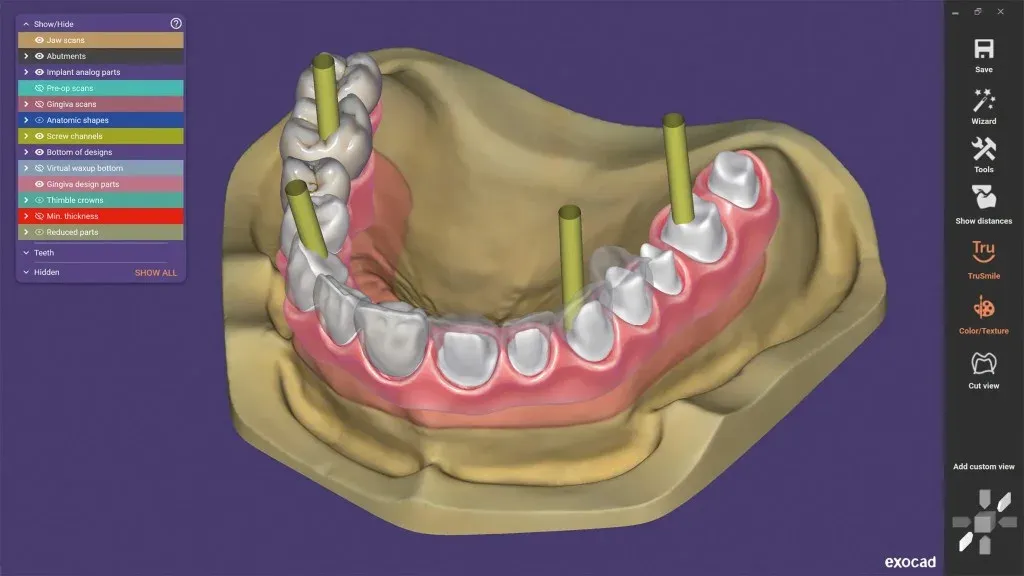
Full-arch plan on screen with the transition line marked against a smile photograph

The Transition Line

Where the Prosthesis Meets Tissue Is Decided on Screen

There is a junction where the prosthesis meets tissue, and if it sits above the lip when the patient smiles, they will see it every time they look in a mirror. Reduce enough — in the right place — and that line hides. This is why we ask for photographs of the lip at rest and in a full smile, and why they are a design input rather than a courtesy.

  • The referenced platform: An irregular ridge gives inconsistent prosthetic height across the arch; a flat, referenced reduction gives the framework a predictable surface to seat on.

  • The smile line: Where the lip falls at rest and in a full smile decides where the transition can be hidden — so the reduction level answers to it, not the other way around.
Learn more
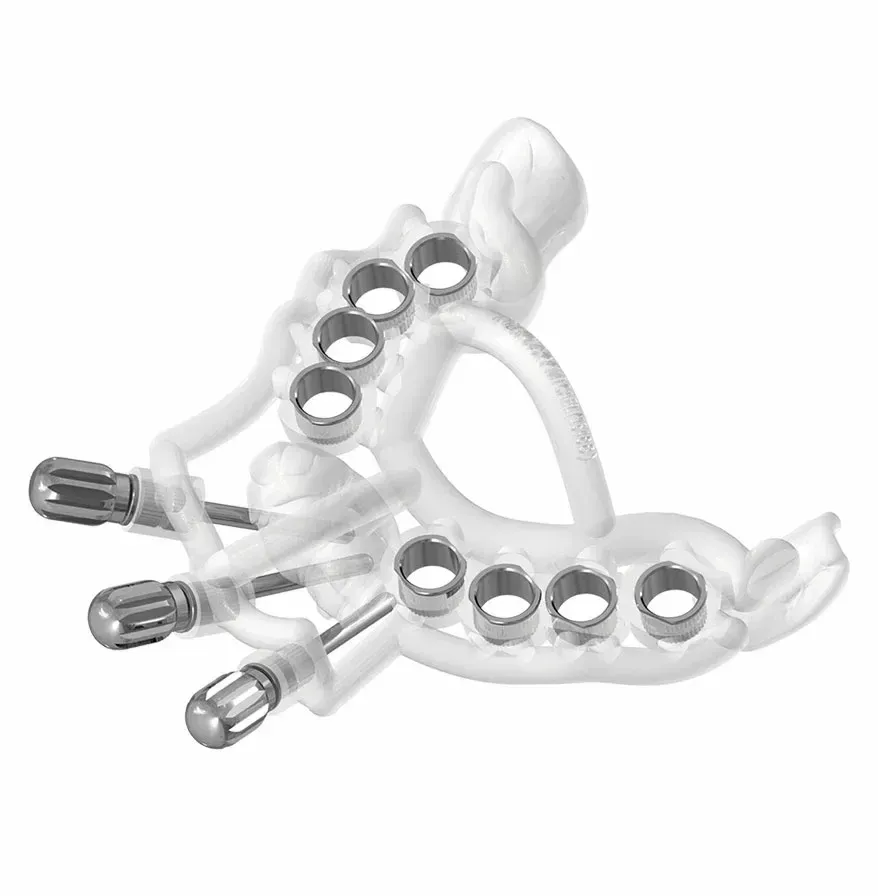
Printed bone reduction guide with fixation pins beside the model it was planned on

Materials & Fabrication

Printed in Biocompatible Resin, Fixated to Stay Put

Reduction guides are printed in biocompatible resin with the fixation the case requires. The guide often works at a moment when the reference teeth are being removed, so how it seats and how it is secured are planned as carefully as the reduction level itself.

Every guide is checked against the plan and shipped as part of the sequence it belongs to, so the reduction guide, the placement guide, and any prosthetic components arrive as one coordinated set rather than three separate parcels.

  • Fixation for the moment it works: The guide is secured for the point in surgery when the reference teeth are gone and the bone is what it has to seat against.

  • Indexed to the stack: Sharing references with the placement guide means the implant guide still seats where the plan put it once the ridge is reduced.

Learn more

Which prosthesis, exactly?

The reduction level follows from the prosthesis, so we ask for it first. Tell us whether the arch is getting an acrylic-on-titanium hybrid, a monolithic zirconia prosthesis, or a bar-retained overdenture — see full arch hybrids — and the vertical room the case needs follows from it. For how the reduction plane itself is derived, see bone reduction guides in surgical support.

The Process

How a Reduction Case Is Planned

From the prosthesis backward to the bone — with your approval before anything prints.

  1. Start from the prosthesis you intend to deliver

    Practice

    Tell us what is going on the arch — an acrylic-on-titanium hybrid, a zirconia prosthesis, or a bar-retained overdenture. Each needs a different amount of vertical room, so the prosthesis defines the reduction, not the other way around.

  2. Send the full-arch records

    Practice

    A CBCT in DICOM, an intraoral scan, the implant system, and photographs showing the lip at rest and in a full smile. The smile line is a design input here, not a nicety.

  3. We set the platform and the transition line

    Lab

    The reduction level is planned so the ridge becomes a flat, referenced platform for the framework — and so the junction where the prosthesis meets tissue sits where the lip will cover it.

  4. You approve before it prints

    Practice

    You review the reduction level, the fixation, and how the guide sequences with the placement guide. Adjusting the plan is a conversation; adjusting the bone afterward is not.

  5. Printed, fixated, and sequenced with the stack

    Lab

    We print in biocompatible resin with the fixation the case needs, inspect it against the plan, and ship it as part of the guide sequence it belongs to.

What a planned reduction actually buys you

  • A platform, not a ridge

    A framework wants a flat, predictable surface to sit against. Converting an irregular ridge into a referenced platform is what makes the prosthetic fit repeatable across the arch.

  • The transition line ends up where you put it

    Reduce too little and the junction between prosthesis and tissue shows when the patient smiles. That line is decided on screen, before the flap is raised — or it is decided by luck.

  • Reduction is prosthetic, done surgically

    How much bone comes off is dictated by the prosthesis the patient is getting. That is a restorative decision the lab should be in the room for, well before the surgical date.

Start a case

Send one case. Keep the scanner.

Open a partner account and your first case moves with a shade record and our remake guarantee — if a unit does not seat, we redo it at no charge.

  • Free 3Shape TRIOS 6 scanner for active partners
  • Under-2% remake rate — remakes at no charge
  • One named technician you reach directly — no call center

Prefer to talk? +1 747-268-0808

No call center — you hear back from the lab, not a bot.

Bone Reduction FAQ

Bone Reduction Guides — Questions Dentists Ask

Send a CBCT in DICOM, an intraoral scan, the implant system, and — the input that matters most here — the prosthesis you intend to deliver. An acrylic-on-titanium hybrid, a zirconia prosthesis, and a bar-retained overdenture do not need the same vertical room, so the reduction cannot be planned without knowing which one is coming. Include photographs of the lip at rest and in a full smile, because the smile line determines where the transition can be hidden.

After the teeth come out, bone is what the guide has to reference. We plan from a CBCT in DICOM registered to an intraoral scan from iTero, 3Shape, or Medit — the reduction plane and guide fixation are planned directly against bone.

How to send a file

Two failures drive full-arch remakes, and reduction touches both. Too little reduction and the prosthesis has no vertical room, so it comes back thin, over-contoured, or fractured. Too little in the wrong place and the transition line shows in the smile. We plan the level against the prosthesis and the smile line, design the guide to produce a flat referenced platform, and index it to the placement guide so what follows still seats where the plan put it.

An undefined prosthetic plan. Timing also depends on complete records, whether the case is immediate-load, and how many guides stack in the sequence — but reduction cannot be planned without knowing which prosthesis is coming.

On full-arch work it is close to mandatory. The reduction level, the implant positions, and the prosthesis are one decision made three times — getting them agreed before surgery is what keeps the case from becoming a compromise. Bring us in before the bone is gone.

Full-arch case planning

Partner Offer

A Free Intraoral Scanner for Partner Practices

Partner with Universal Dental Lab and we place a 3Shape TRIOS 6 Wireless in your operatory — free for the length of our partnership. Scan the prep, send it in seconds, and skip impressions entirely.